Cigar Display Humidors for Stores: Countertop, Cabinet, or Walk-In (2026)
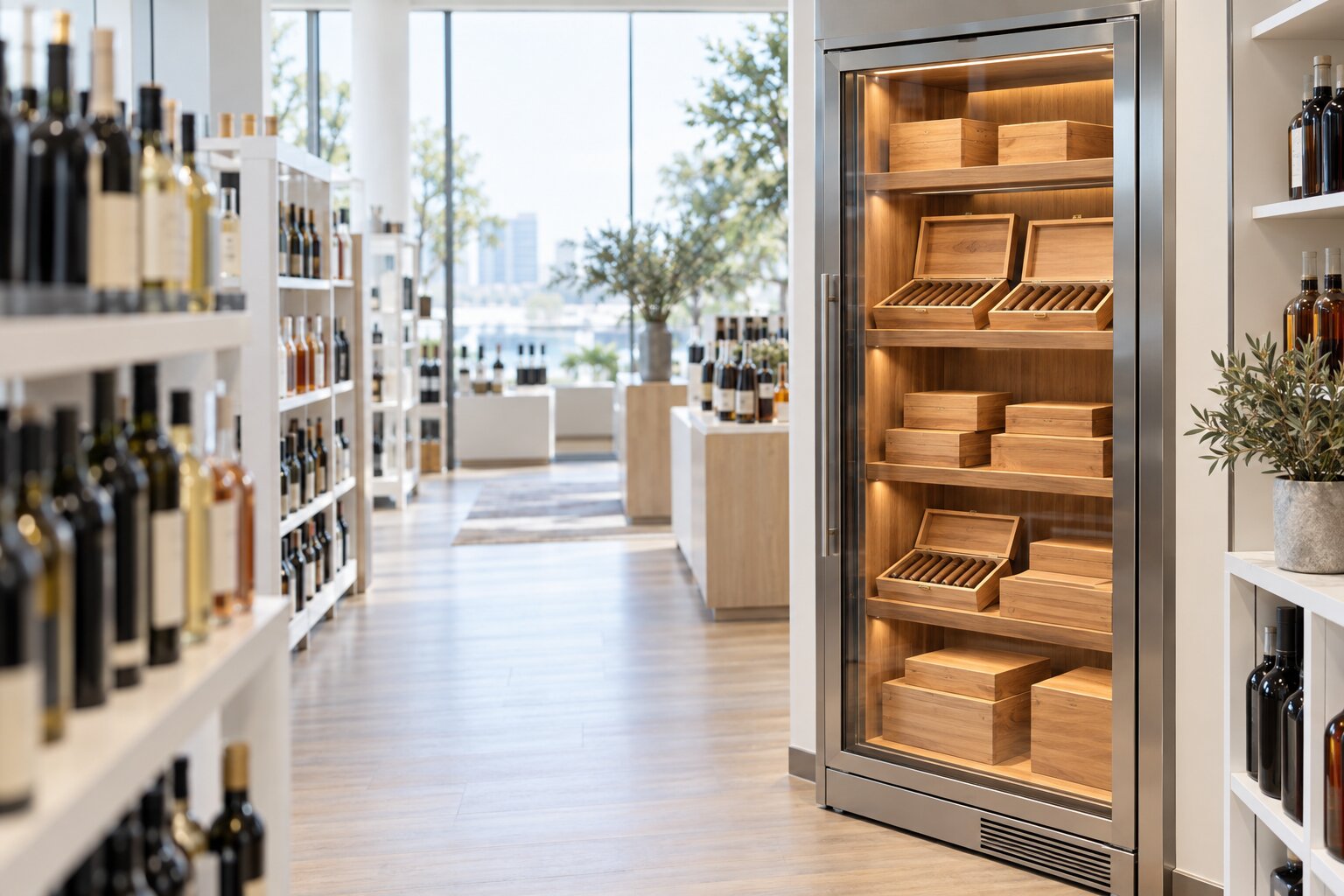
Key Takeaways
- Size the cigar display humidor from the assortment you can sell. Picking the case first and filling it later is how stores end up with dry, dead stock.
- A store humidor must hold 65 to 70% relative humidity and 65 to 70°F steadily (Lucrative Cigars), in a room where doors open and the air conditioning cycles all day.
- Countertop units suit impulse sales at the register, cabinets suit a real cigar section, and walk-ins suit destination shops and lounges.
- Temperature matters as much as humidity. Tobacco beetle adults become active above 65°F (Purdue Extension), so a case that sits in the sun or next to a heat source is a risk.
- Federal rules apply to every sale: customers must be 21 or older, and anyone under 30 must show photo ID (FDA). Check your state's rules before you choose an open display.
A regular picks up a bottle of bourbon and asks if you've got a decent cigar to go with it. You do, sort of. There's a box by the register that's been there since spring, and those cigars are dry.
If customers keep asking, a proper cigar section is a sensible next step for a liquor store, a convenience store, a bar, or a golf shop. The humidor is the first big decision, and it's easy to get it backward. It's tempting to pick an attractive case and then work out how to fill it.
This guide works the other way round. Start from what you can realistically sell and choose the case to fit.
What a display a humidor must do in a store
A humidor's job is simple to state and hard to do on a shop floor: keep cigars at a steady humidity and temperature. Lucrative's storage guidance is 65-70% relative humidity and 65-70°F. Stability matters more than hitting an exact number, because wide swings crack wrappers and can lead to mold.
That's easy in a quiet cabinet at home. A store is harder. The front door is open all day, and the air conditioning cycles on and off. Customers also open the case to browse. Every one of those moments pulls the humidor away from where you set it.
Placement is essential to functionality. The same guidance says to keep humidors from direct sunlight and away from heat vents and air conditioning drafts. In a store, that rules out a few obvious spots:
- A sunny front window. Great for visibility, but the sun heats the case through the glass.
- Beside a heat vent or under an air conditioning outlet. The airflow dries or chills the case every time the system runs.
- Next to equipment that runs warm. Coolers, ice machines, and coffee equipment all emit heat from their motors or heating elements.
The register is often the natural home for a small humidor, since that's where impulse sales happen. It can work well, if the counter isn't in a draft or in full sun.
Countertop, cabinet, or walk-in: the three formats compared
Display humidors come in three broad formats. Each fits a different kind of store.
Format | Best for | Space it needs | How it holds humidity | Watch for |
Countertop humidor | Impulse sales at the register and testing demand | A small section of counter | Passive packs or pillows, or a small electronic unit | Opened constantly, so humidity needs checking often |
Cabinet or tower humidor | A real cigar section with many lines | A floor spot out of sun and drafts | Electronic humidification; some models also control temperature | Whether it controls temperature as well as humidity |
Walk-in humidor | Destination cigar shops and lounges | A dedicated room and a build-out | Room-scale humidification and cooling | The biggest commitment in cost and planning |
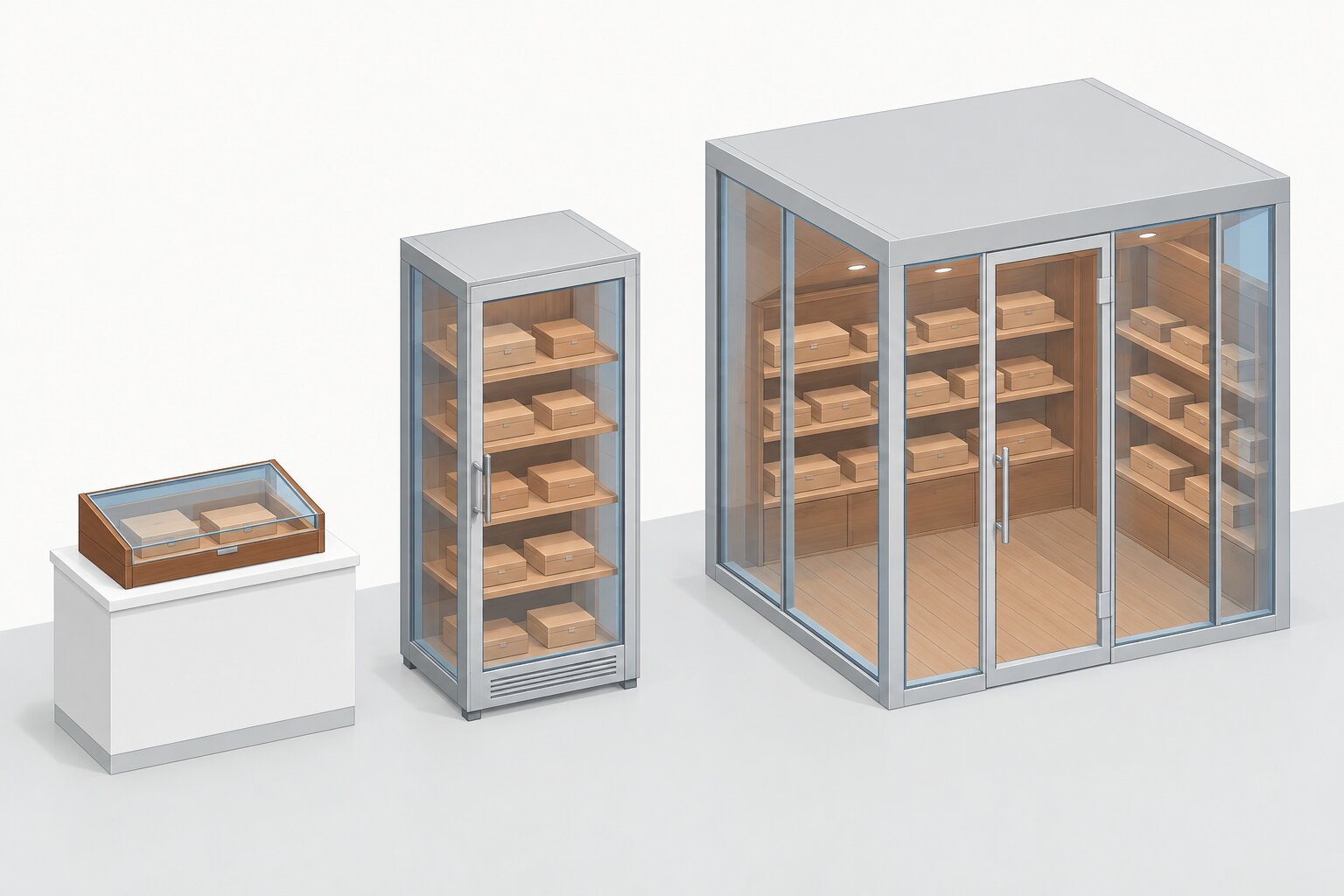
Humidor makers usually quote capacity as a cigar count, like "250 cigars" or "1,500 count". Treat that number with care. It tells you how many loose cigars fit and how many boxes a store stocks. Ask the maker what cigar size the count assumes and how many standard boxes fit on each shelf. Better still, take a couple of real boxes with you when you shop.
Prices vary widely with size and features, and a quote for a cabinet that only manages humidity isn't comparable to one that also cools. When you compare, ask the same questions of every unit:
- Does it control temperature, or only humidity?
- How many standard boxes fit, shelf by shelf?
- Does the door lock?
- What does the humidification need from you each week, such as refills, cleaning, or calibration?
Which format fits your kind of store
The right format depends on where cigars fit in your store and how your customers buy.
Liquor stores. Cigars sit naturally next to spirits, and gift buying brings in customers who want both. If you're testing demand, start with a countertop unit near the register. Once cigars are selling, a cabinet near the premium spirits lets customers browse the two together.
Convenience stores. Space is tight, and tobacco already sells at the counter. A countertop humidor beside or behind the register is the natural start, with tins and tubes filling out the range. A cabinet only makes sense once you've proved steady demand for boxed lines.
Bars and restaurants. A small cabinet behind the bar lets staff offer cigars like any other item on the menu. Whether customers can smoke on your premises, even on a patio, depends on your state and city smoke-free laws. Check those first, because selling cigars to take away is simpler than selling them for on-site use.
Golf shops. Demand follows the season, and customers carry cigars out onto the course. A countertop unit in the pro shop, sized for peak season, usually covers it. Tube cigars suit golfers because the tube protects the cigar in a bag.
Passive or active humidification
There are two ways to keep a humidor humid, and the right one depends on the case's size and how often it's opened.
Passive humidification refers to packs, pillows, or beads that release moisture without power. They're simple and quiet, and they suit small, stable spaces like a countertop unit—lucrative stocks, passive options, including Boveda 320Gm packs and Fujima Water Pillows. The trade-off is capacity. A case that's open all day can use up moisture faster than passive products can replace it.
Active humidification means an electronic humidifier that senses humidity and adds moisture when it drops. That's the better fit for cabinets and anything opened often. Lucrative carries the Cigar Oasis Magna 3.0 Humidifier, an electronic unit designed for larger spaces such as cabinets and walk-ins. Size any unit to the case using the manufacturer's specs.
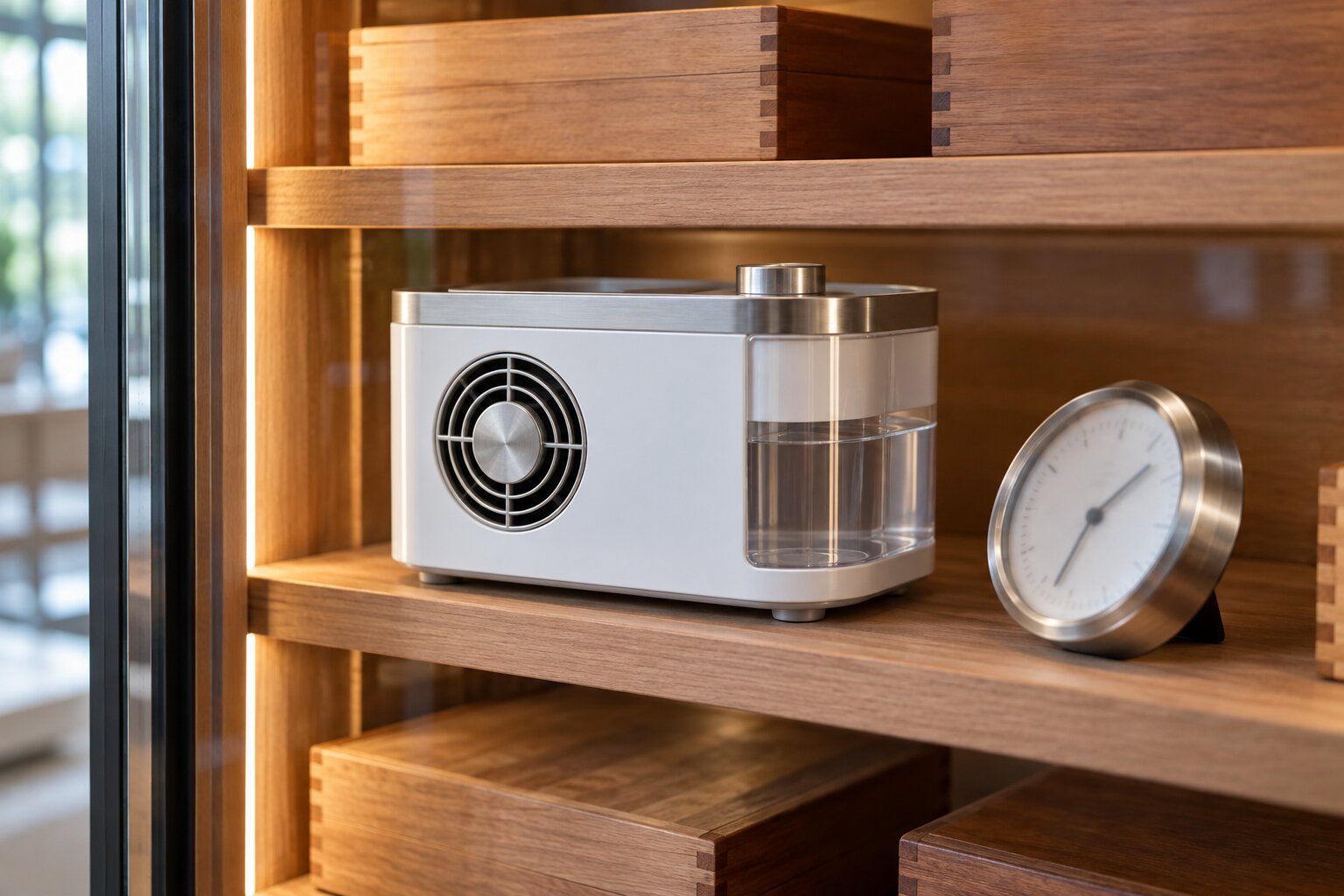
Whichever you choose, pair it with a hygrometer you trust and calibrate it before relying on it. The full range is in Lucrative's cigar accessories.
Temperature is the part stores forget.
Most humidor advice focuses on humidity. In a store, temperature deserves as much attention as it does, and it's harder to control because it depends on the whole room.
It matters for cigars and for pests. Tobacco beetle adults become active above 65°F (Purdue Extension, 2018), and warmth speeds up their whole life cycle. A case that drifts warm through the summer gives them what they need.
That's why the "does it control temperature?" question above matters. A cabinet that only manages humidity is only as cool as your store. If your sales floor runs warm in summer, or the case must sit somewhere less-than-ideal, a unit with cooling is worth the difference. At least, put a thermometer inside the case and check it every day.
Size it from the assortment backward.
There are two easy ways to get a cigar section wrong: too much case for the stock, or too much stock for the demand. Start with the demand.
- Estimate weekly sales honestly. Look at how often customers ask, and what similar stores in your area sell, if you know.
- Choose your lines. A few names customers already know, plus a couple of discovery lines. Start small and let requests tell you what to add.
- Pick formats. Five-packs, samplers, tins, and tubes let you offer variety without buying full boxes of everything.
- Then size the case. Count the boxes and packs you'll hold, leave room to grow, and choose the humidor that fits them.
Here's an illustrative example with round numbers. Say you expect to sell about 20 cigars a week at first. You stock eight lines as 5-packs (40 cigars) and four best sellers as boxes of around 15 (60 cigars). That's roughly 100 cigars, or about five weeks of stock at that pace. A countertop unit or a small cabinet holds that comfortably, with room to add lines as you learn what sells.
For which brands suit which kind of store, this guide to the best wholesale cigars by customer type covers liquor stores, golf clubs, and more. Sampler packs are a low-risk way to find out what your customers like before you commit to boxes.
Timing helps too. If you're adding cigars in the fall, you'll open the section right before the gift season. Here's how retailers use holiday samplers and gift inventory in Q4.
Tins and tubes: selling cigars before you own a humidor
You don't have to buy a humidor to start testing demand. Two formats give you some room.
Tube cigars come in individual tubes, while cigar tins hold smaller cigars and cigarillos. Both protect the cigars better than an open box on a shelf. Both suit a counter display near the register.
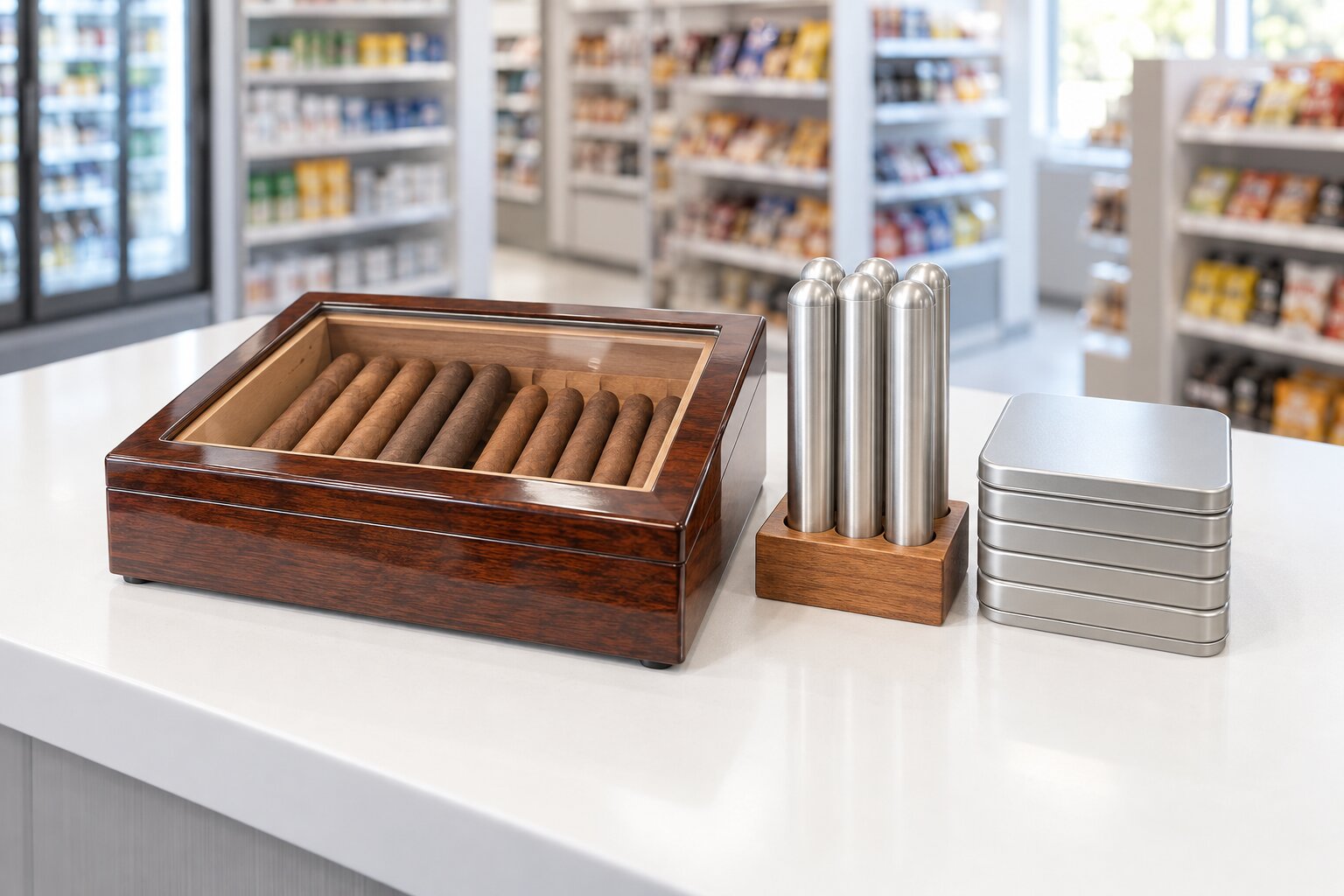
Cellophane, for example, is semi-porous and allows some humidity to pass through (Lucrative Cigars FAQ). Packaging slows moisture loss, but it doesn't stop it. Keep quantities small and move older stock to the front so it sells first.
If tins and tubes sell steadily, that's your evidence for a countertop humidor and a few 5-packs. This comparison of bundles, samplers, and tins explains when each format earns its space.
Placement, locks, and the rules at the counter
Adding cigars means adding tobacco compliance. The federal basics apply to every store (FDA retail requirements, current as of September 30, 2024):
- Sell only to customers 21 or older.
- Check photo ID always. This took effect on September 30, 2024.
- No vending machines where people under 21 are present or allowed in.
- No free samples.
What about open displays? The FDA's federal restriction on self-service displays names cigarettes and smokeless tobacco, not cigars. Some states and cities restrict tobacco displays more broadly, though, so check your local rules before you put an open, customer-browsable humidor on the sales floor. A lockable case is also simply practical. It keeps staff involved in every cigar sale, and that's where the ID check happens.
You'll also need the right license. Tobacco licensing happens at the state level. In Georgia, for example, anyone selling tobacco to consumers’ needs a tobacco retailer license from the Department of Revenue, with a $10 annual license fee. That's separate from a liquor license.
Your distributor will ask for it too. Lucrative's wholesale application requires your Tobacco Resale License, so sort out the license before you place your first order.
Setting it up and keeping it right
A new humidor needs a little preparation before any stock goes in.
- Calibrate the hygrometer. You need to trust the number before you act on it.
- Season the case. Spanish cedar shelves start dry, and if you stock them straight away, they pull moisture out of the cigars. Bring the humidity up gradually and wait until it holds steady in your target range for several days.
- Stock it. Put the lines you expect to sell fastest where customers see them first.
Once it's running, the routine is short. Check the humidity and temperature every day and write them down. Refill or maintain the humidification on the maker's schedule. Rotate stock so older boxes sell first and never let a slow line sit for months.
This guide to keeping a retail humidor stable covers the day-to-day in more depth.
Who opens the case, and what they should know
A humidor sells best when someone can answer a question about what's inside it. You don't need a trained tobacconist behind the counter, but whoever opens the case should know four things:
- The ID rules. Customers must be 21 or older, and anyone under 30 must show photo ID—no exceptions, even for regulars who look older.
- The lines you carry. A one-line description of each is enough: its strength (mild, medium, or full) and its size. Distributor product pages and manufacturer notes are a good place to start.
- How to handle stock. Close the case after every sale, handle cigars gently, and keep the oldest boxes at the front.
- The daily check. Who reads the hygrometer and thermometer each day, and what to do when a reading is out of range.
A small card on each shelf with that one-line description helps new staff and customers alike. It also means the case opens less often for browsing, which helps keep the humidity steady.
When to move up a size
A countertop unit is a good way to start, but it isn't always the best place to stay. These are the signs you've outgrown your case:
- It's full, and you're turning away new lines. If requests keep coming for cigars you have no room for, the case is limiting sales.
- Your best sellers keep running out. If you can't hold enough of the lines that sell, you need more shelf space or a faster reorder rhythm, and often both.
- Humidity won't hold. A small passive case that's been open all day can struggle to stay in range moving it to a cabinet with electronic humidification fixes that.
- You're buying boxes, not packs. Once full boxes are selling through, a cabinet shows them properly and keeps them in better condition.
For most liquor stores, c-stores, bars, and golf shops, the step-up is from countertop to cabinet. A walk-in is a different kind of commitment. It suits specialist cigar shops and lounges, and it's rarely the right move for a store where cigars are one category among many.
Checklist before you buy a display humidor
- You've estimated weekly sales and chosen your first lines and formats.
- You've counted the boxes and packs you'll hold, plus room to grow.
- You've picked a spot out of direct sun and away from vents and warm equipment.
- You know whether the unit controls temperature and humidity.
- You've chosen passive or active humidification to match the case size.
- You have a hygrometer and a thermometer inside the case.
- You've checked your state and city rules on tobacco licensing and displays.
- Your staff knows the ID rules: 21 and older, with photo ID for anyone under 30.
The short version
A cigar display humidor should be sized for what you'll sell, not the other way round. Estimate demand and choose a small set of lines and formats. Then pick the case that holds them and has room to grow. For most stores, starting, that's a countertop unit or a small cabinet.
Put the case where the sun and drafts can't reach it, and choose humidification to match passive for small, quiet cases and electronic for cabinets that are opened all day. Watch temperature as closely as humidity and keep stock moving so nothing sits for months.
Before you order, get your tobacco license in place and brief your staff on ID checks. When you're ready to stock the case, apply for a wholesale account with Lucrative Cigars.
Frequently asked questions
How much does a commercial humidor cost?
It depends mainly on the format and features. Countertop units cost the least; cabinets vary by size and whether they control temperature; and walk-ins require a build-out. Compare quotes on the same basis: box capacity per shelf, temperature control, locking, and weekly maintenance.
What humidity should a cigar display humidor be set to?
Lucrative's guidance is 65-70% relative humidity at 65-70°F. Stability matters more than an exact number, so pick a point in that range and keep the case there. Check it daily with a calibrated hygrometer.
Can you sell cigars without a humidor?
For a short time, in protective formats like tubes and tins, if they sell quickly. Packaging slows moisture loss but doesn't stop it, so it's a way to test demand, not a long-term setup. Boxed cigars left on an open shelf will dry out.
Do liquor stores need a special license to sell cigars?
In many states, yes. Georgia, for example, requires a tobacco retailer license from the Department of Revenue for anyone selling tobacco to consumers, separate from a liquor license. Check with your state's revenue department for the rules in your state.
Countertop or cabinet: which is better for a small store?
Start with a countertop unit if you're testing demand with a handful of lines. Move to a cabinet once you're stocking more lines than it can comfortably hold, or if you need temperature control. A cabinet's electronic humidification also handles frequent opening better.