Wholesale Cigar Bundles, Samplers, and Tins: When Retailers Should Use Each | Lucrative Cigars
Wholesale Cigar Bundles, Samplers, and Tins: When Retailers Should Use Each
Cigar format strategy is one of the most underutilized levers in cigar retail. Most buyers focus on brand selection and price tier, which are essential, but the physical format in which a cigar is sold determines the purchase decision at least as much as the brand name on the label.
A cigar that would never sell as a single stick or a full box can become a strong performer as a sampler pack. A premium brand that moves slowly off the humidor shelf can become a fast-moving checkout item in a tin or a tube. Understanding the mechanics of each format and matching format to retail environment is the difference between inventory that works and inventory that sits.
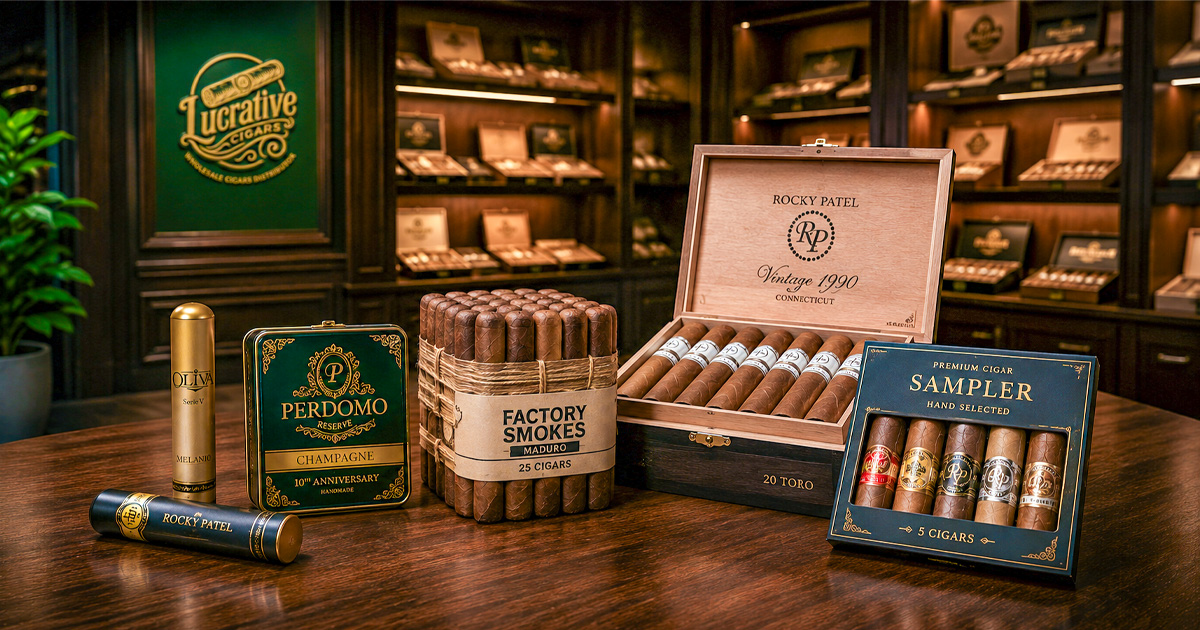
This guide covers the five primary wholesale cigar formats available to retailers: bundles, samplers, tins, tubes, and full boxes. For each format, it explains the commercial logic, the customer it serves best, the retail environment where it performs most strongly, and the margin and pricing strategy that maximizes its contribution to overall program profitability. Retailers who build a deliberate format mix rather than defaulting to full boxes across the board consistently see better sell-through, higher average transactions, and more floor-level flexibility in their buying programs.
For context on how format strategy fits within a broader retail cigar program, see the complete guide to best wholesale cigars for retail stores by customer type.
The five cigar retail formats: a practical comparison.
Before examining when to use each format, it is useful to understand what distinguishes them at both the product and commercial levels.
| Format | Best Customer | Margin Profile | Best Retail Setting |
|---|---|---|---|
| Bundle (25ct) | Value-driven regular smoker | Strong per-stick margin at volume | Smoke shops, tobacconists |
| Sampler Pack (4-5ct) | New customers, gift buyers | High per-stick, low commitment | All formats, events, gifting |
| Tin (5-10ct) | Impulse buyers, casual smokers | Moderate, convenience premium | Liquor stores, convenience, golf |
| Tube (single/3-5ct) | Occasional buyers, gifting | Strong single-unit margin | Checkout, liquor stores, clubs |
| Full Box (10-25ct) | Loyal regulars, high-spend buyers | Best per-stick at commitment | Smoke shops, lounges |
Each format occupies a distinct position in the retail experience. The art of format strategy is knowing which position your customer and your floor space call for at any given moment in your program.
Cigar bundles: what they are and when retailers should prioritize them.
What makes a bundle different from a box. A cigar bundle is a quantity pack, typically 20 to 25 cigars, wrapped together without individual cedar packaging or elaborate box presentation. Bundle cigars are often factory seconds or production overruns from premium manufacturers, which means the tobacco quality often matches that of higher-priced boxed products at a significantly lower per-stick cost. The difference is in presentation, not always in blend quality.
A full box, by contrast, is the manufacturer's primary retail packaging, usually cedar-lined, with a per-stick price that reflects both the tobacco and the packaging investment. Boxed cigars deliver stronger brand storytelling at the point of sale and position better as premium shelf products. Bundle cigars offer a value proposition, which is a distinct and legitimate commercial message for a different customer segment.
When bundles perform best. Bundle cigars are the right format for customers who are regular smokers and prioritize value per smoke over brand presentation. The smoke shop customer who visits two or three times a week, who knows exactly what they like, and who does not need a cedar box to validate their purchase is the bundle customer. Factory Smokes Maduro, Factory Smokes Sungrown, and Factory Smokes Sweets are exactly the products that serve this customer well. Per-stick cost is low, quality is consistent, and the 25-count quantity fits the buying pattern of a regular smoker who does not want to restock every week.
Retailers should prioritize bundle inventory when their core traffic is made up of experienced daily or near-daily smokers, when shelf space favors high-volume, premium-turnover presentation, and when they want to offer a strong value tier without discounting their boxed inventory. Bundles earn their place in the program by delivering margin on volume, not on per-unit premium.
Margin reality for bundle cigars. Per-stick wholesale cost for bundle cigars is typically lower than for comparable boxed products, creating margin flexibility at the retail price point. A retailer who prices bundle cigars aggressively generates high transaction frequency and builds loyalty among value-oriented regulars. A retailer who prices bundle cigars at a modest markup to boxed alternatives captures both the value message and improved margin per unit. Both approaches are valid depending on the competitive environment and the customer base.
Cigar samplers: reducing inventory risk and driving trial purchases.
Why samplers are a risk management tool. A sampler pack is the most versatile format in the wholesale cigar retail toolkit. It serves the new customer who wants to explore without committing to a full box, the gift buyer who wants a presentable multi-cigar purchase, the lounge operator who wants to test a new brand before ordering by the box, and the retailer who wants to introduce a new supplier relationship at low capital risk.
The sampler packs category covers a range of brand-specific and multi-brand options. A Perdomo sampler, a Rocky Patel sampler, a Romeo y Julieta sampler, or a Plasencia sampler each introduces a customer to a brand's range without requiring the buyer to have detailed knowledge of individual SKUs. This is particularly valuable for retailers whose staff have limited or inconsistent cigar knowledge.
Samplers and the trial purchase funnel. The trial purchase dynamic that samplers create has long-term inventory implications that most retailers undervalue. A customer who purchases a 5-pack sampler and finds one or two sticks they love within it is primed to return and purchase a full box of those specific blends. The sampler functions as a paid product test, generating both immediate revenue and future full-box demand. This is one of the clearest examples of short-term format investment creating long-term inventory return.
Retailers who stock samplers alongside their full-box inventory of the same brands effectively create a two-step customer journey: sample on the first visit, commit on the second. This structure increases repeat visit frequency and average transaction value across the program, not just on the sampler sale itself.
Seasonal gifting opportunities. Samplers are the strongest gift-purchase format in cigar retail. At the $35 to $75 price point, a well-packaged 4-pack or 5-pack sampler from a recognizable brand competes directly with bottle gifts, accessory sets, and food gifts for the occasion buyer who wants to give something premium and distinct.
Valentine's Day, Father's Day, and graduation season are secondary gifting peaks that reward retailers who maintain year-round sampler inventory depth rather than treating them as seasonal categories. A customer who buys a sampler as a gift in June and receives positive feedback from the recipient becomes a repeat gifting buyer in December.
Cigar tins: the impulse purchase format.
Why tins work in non-specialist retail. Cigar tins occupy a unique commercial position in the retail landscape. They are the format best suited to environments where the customer is not primarily a cigar enthusiast, where the purchase decision is made quickly and with limited product knowledge, and where convenience and brand familiarity drive the transaction more than blend complexity or wrapper origin.
The cigar tins category includes options like Romeo y Julieta Minis and Montecristo Spain Classic Mini Tins. These products carry brand names with strong consumer recognition, come in a format size that is accessible as an impulse or occasional purchase, and require no humidor storage for short-term display. For liquor stores, convenience stores, and golf club pro shops, tins are the logical first entry into the cigar category.
Shelf placement for tins. The placement principle for cigar tins is simple: put them where decisions are already being made. The checkout counter is the highest-performing position in most non-specialist retail environments. A tin of Romeo y Julieta Minis at the register captures the same impulse-adjacent purchase energy as a chocolate bar or a lip balm. The customer is already opening their wallet. The price is accessible. The brand name registers without requiring explanation.
In environments with more floor space, a secondary tin display near spirits or near the front entrance can capture occasion-driven purchases before the customer reaches the checkout area. A small basket or tiered counter display near premium bourbon or single malt scotch generates cigar purchases from customers who associate the two products and appreciate the proximity suggestion.
Cigar tubes: single-stick format for maximum flexibility.
Tubes as a bridge format. Tube cigars occupy the space between the impulse-buy accessibility of a tin and the commitment of a sampler pack or bundle. A single cigar in an aluminum or plastic tube is the right format for the customer who wants to purchase one premium cigar without buying a pack, and for the retailer who wants to merchandise premium brands at the counter without requiring full-box stock depth. The tube cigars category includes options across multiple brands and strength profiles, from the H. Upmann by AJ Fernandez Toro Tubo 5-pack to Rocky Patel Decade and Rocky Patel Royale tubed singles.
Where tubes perform best. Tubes are particularly effective in three retail environments. In golf clubs and country clubs, a premium single-tube cigar from Cohiba or Rocky Patel at $15 to $25 is a natural add-on purchase to a round of golf. The tube format protects the cigar during transport and communicates premium quality through its packaging. In cigar lounges, a display of tubed singles near the register attracts customers who came for a session but decide to take one home. In liquor stores with a limited cigar selection, tubes allow retailers to offer premium brands without committing to full humidor infrastructure.
Tube cigars also serve as effective upsell vehicles at checkout in smoke shops. A customer purchasing a bundle or a box of affordable cigars is a reasonable candidate for a premium single-tube upgrade at the counter when it is positioned as "the one to try tonight." This cross-sell pattern increases average transaction value without requiring a hard sell.
Full boxes: the committed customer format.
Full boxes are the backbone of the smoke shop and lounge inventory, but the wrong default format for every other retail environment. A full box purchase requires the customer to know what they want before they arrive, have humidor storage capacity at home or in the lounge, and be willing to commit capital to a single SKU. That is a specific customer profile that describes the regular, experienced cigar buyer, not the occasional or gift purchaser.
For smoke shops and lounges, the cigar boxes category provides the depth of brand and blend selection that committed buyers expect. Full-box inventory from Padron, Oliva, Rocky Patel, Perdomo, Arturo Fuente, and Gurkha belongs at the core of any serious humidor program. But even in these environments, full boxes should be complemented by samplers, tubes, and at least one bundle option to serve the full range of customer types who walk through the door.
Format mix strategy by retail environment.
Smoke shops.
- Core: full boxes across three price tiers covering mild, medium, and full-body profiles
- Secondary: bundle cigars for value-tier regular smokers
- Support: sampler packs for new customers and the gift buyer segment
- Counter: tube singles from premium brands as an upsell at checkout
Liquor stores.
- Core: cigar tins from recognizable brands positioned near checkout and spirits
- Secondary: tube singles from premium brands as an impulse and occasion purchase
- Support: sampler packs for gift buyers during the holiday season and Father's Day
- Optional: a small selection of boxed cigars if space and humidor infrastructure permit
Golf clubs and country clubs.
- Core: tube singles from prestigious brands positioned at the pro shop counter
- Secondary: sampler packs as gifts and tournament prize inventory
- Support: cigar tins for accessible impulse purchases near the 19th hole or bar
Cigar lounges.
- Core: full boxes across all strength tiers and price levels
- Secondary: sampler packs to test new SKUs and serve the gifting customer
- Support: tube singles near the register for take-home purchases
- Seasonal: limited-edition samplers and tins during the holiday gifting season
Convenience stores.
- Core: cigar tins from nationally recognized brands at accessible price points
- Support: individual tube cigars or small packs at checkout
Cross-selling opportunities across formats.
The most effective format strategy is not choosing one format but building a program where formats work together to increase the value of each customer transaction. Cross-selling across formats is the mechanism that creates that compounding effect.
A customer purchasing a full box of Perdomo 10th Anniversary Maduro is a natural candidate for a Perdomo sampler to introduce them to other lines in the Perdomo portfolio. A customer buying a tin of Romeo y Julieta Minis is a candidate for a step-up recommendation to a Romeo y Julieta sampler on their next visit. A customer who has worked their way through a sampler and identified a favorite blend is ready to hear about the full box.
In lounges and smoke shops, staff-driven cross-sells between formats consistently outperform passive shelf merchandising. A brief conversation at the counter that connects a customer's current purchase to a complementary format, whether it is a sampler that expands on a brand they enjoy or a tube single they can take home from their lounge session, is the practical mechanism through which format strategy generates above-average transaction values.
Cigar accessories also provide a natural cross-sell layer across all formats. Pairing cigar cutters or cigar bags with a bundle or sampler purchase increases the average ticket without requiring an additional tobacco decision. For customers new to cigars, a cutter positioned next to a sampler display creates a natural bundle opportunity that serves the buyer and improves margin per transaction.
|
Source Every Cigar Format at Wholesale Prices Lucrative Cigars stocks wholesale cigar bundles, sampler packs, tins, tubes, and full boxes from the industry's top brands. Build the right format mix for your retail environment and customer base. Shop Cigar Bundles | Browse Sampler Packs | Apply forWholesale Access |
Frequently Asked Questions
Are cigar bundles profitable for retailers?
Yes, cigar bundles are consistently profitable for retailers who stock them in the right environment. The per-stick wholesale cost of bundle cigars is typically lower than comparable boxed products, creating strong margin flexibility at the retail price point. Bundle cigars earn their highest returns in smoke shop environments where the core customer is a regular smoker prioritizing value over presentation. In environments where the bundle format does not match the customer profile, the margin advantage is reduced by slow turn and shelf space cost. Format fit matters as much as the margin structure.
What is the difference between cigar bundles and boxes?
The primary difference is presentation and context, not always tobacco quality. A cigar bundle is a quantity pack, typically 20 to 25 cigars, without cedar box packaging or elaborate brand presentation. A full box is the manufacturer's primary retail package with cedar lining and full brand storytelling. Bundle cigars are frequently factory seconds or production overruns from premium manufacturers, meaning the blend quality is often comparable to boxed product at a lower per-stick cost. Boxes carry a stronger shelf presence and are better suited to customers who associate packaging with quality. Bundles serve customers who prioritize value and consistency over presentation.
Why do cigar samplers sell well?
Cigar samplers sell well because they solve a genuine problem for multiple customer types simultaneously. The new smoker does not yet know what they like, and a sampler reduces the cost of finding out. The gift buyer wants a premium presentable purchase without needing detailed product knowledge. The experienced smoker exploring a new brand wants to try the range before committing to a full box. The lounge operator wants to test customer demand before a wholesale commitment. Samplers meet all of these needs at a price point that feels accessible relative to the discovery value they deliver.
Which cigar formats work best near checkout counters?
Cigar tins and tube singles are the strongest checkout-counter formats. Tins from brands like Romeo y Julieta and Montecristo carry instant consumer recognition, are priced within the impulse purchase range, and require no explanation from staff. Tube singles from premium brands like Rocky Patel and Cohiba work well in smoke shops and lounges where the checkout customer is already a cigar buyer and is receptive to a step-up recommendation. Sampler packs can perform at the counter in gift-heavy retail environments, particularly during holiday and occasion gifting peaks. However, their larger footprint makes them better suited to a secondary display position than a tight checkout area.