Tobacco Beetles in a Retail Humidor: How to Prevent Them and What to Do If You Find One (2026)
Key Takeaways
- Tobacco beetles (also called cigarette beetles) are one of the most serious pests of stored tobacco, and the cigars they attack end up with holes eaten through them (Athanassiou et al., 2018; Penn State Extension).
- A humidor runs close to beetle-friendly conditions. Adults are active above 65°F, and the species does best at 70 to 80% humidity (Purdue Extension), while humidors are usually kept at 65 to 70°F and 65 to 70% RH.
- Temperature is your main lever. In a 2021 lab study, beetles took about 98 days from egg to adult at 21°C (70°F) and about 44 days at 33°C (91°F) (Wang et al., 2021).
- Freezing works when it's done properly. The most cold-hardy stage reached 99% mortality after 7.2 hours at −15°C (Imai and Harada, 2006), so 72 hours at 0°F (−18°C) in sealed bags leaves a wide margin.
- Run beetle control as a routine: inspect every delivery within the 48-hour claim window, and keep pheromone traps and a daily temperature log going all year.
It's August. You're facing boxes in the walk-in, and you notice a tiny round hole in a wrapper. There's a little fine powder on the shelf under the box.
That's what tobacco beetle damage looks like. One damaged cigar isn't a crisis. What matters is how many other boxes the beetles have reached, and whether the conditions in your humidor are helping them along.
The awkward part is that the conditions that keep cigars in good shape are close to what beetles like. So, for a retailer, beetle control is mostly a routine you run year-round, based on temperature and what you check when stock arrives. Freezing is the fix for when that routine slips.
What a tobacco beetle is
The tobacco beetle is Lasioderma serricorne, also called the cigarette beetle. Adults are about a tenth of an inch long (2 to 3 mm), oval, and reddish-brown. The head bends down at nearly a right angle to the body, so from the side the beetle looks humped (Penn State Extension).
The larvae are small, yellowish-white grubs with a brown head. They do most of the damage. For 30 to 50 days, they tunnel through whatever they're feeding on, and in your humidor, that's the filler and wrapper of your cigars. Adults live two to four weeks, and a female can lay up to 100 eggs (Penn State Extension).
They don't only eat tobacco. The same beetle infests stored grains, spices, raisins, seeds, and dried flower arrangements (Penn State Extension). That matters in a shop. A forgotten box of snacks in the back office or a dried-flower display near the counter gives them somewhere to live right next to your stock.
Why your humidor is close to what beetles like
Here's what Purdue Extension's entomologists report about the species. Adults are active above 65°F. Larvae slow down and go inactive between 60 and 66°F, and go dormant below 60°F. The beetles do best at 70-80% humidity (Purdue Extension, 2018).
Now compare that with a well-run humidor. Lucrative's storage guidance is 65-70% relative humidity and 65-70°F. Your humidor sits right at the temperature where adult beetles switch on, with humidity just under their favorite range.
A 2021 laboratory study shows what that means in practice. Researchers raised tobacco beetles on tobacco leaf at 75% humidity and five temperatures. At 21°C (about 70°F), it took about 98 days to go from egg to adult. At 30°C (86°F), it took about 46 days, and at 33°C (91°F), about 44 days. Females laid more eggs in the heat as well: about 13 each at 21°C, against about 40 at 33°C (Wang et al., 2021).
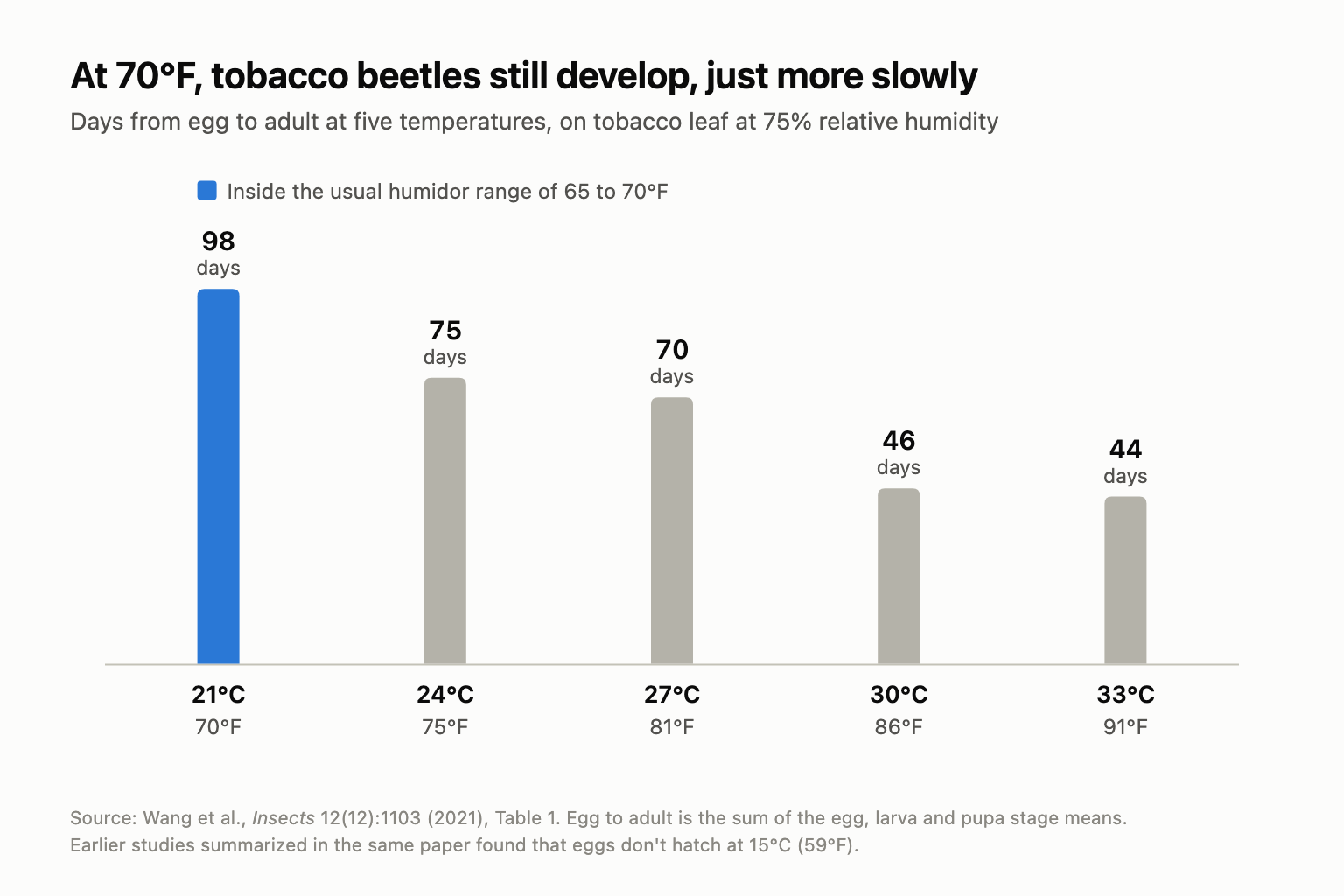
So 70°F doesn't stop them. It slows them down. A failed air conditioner in August speeds everything up, and so does a humidor that bakes in the afternoon sun. At the cold end, earlier studies summarized in the same paper found that eggs don't hatch at 15°C (59°F).
How beetles get into a humidor
Tobacco beetles are one of the most serious insect pests of stored tobacco (Athanassiou et al., 2018). They can arrive in stock. Eggs are laid singly on the tobacco, and larvae feed out of sight, so a box can look perfect when it's delivered and still carry them.
They can also come in on other goods, like the spices and dried goods above. Adults are drawn to light, and museum pest managers monitor them with UV light traps for that reason (IPM Working Group, 2019).
Timing is what catches retailers out. In good conditions, the whole life cycle takes six to eight weeks (Penn State Extension). By the time you see a hole in a wrapper, beetles have been feeding in that cigar for weeks, and the next generation may already be in the boxes beside it.
The signs your staff should know
Anyone who restocks or faces the humidor should know what to look for:
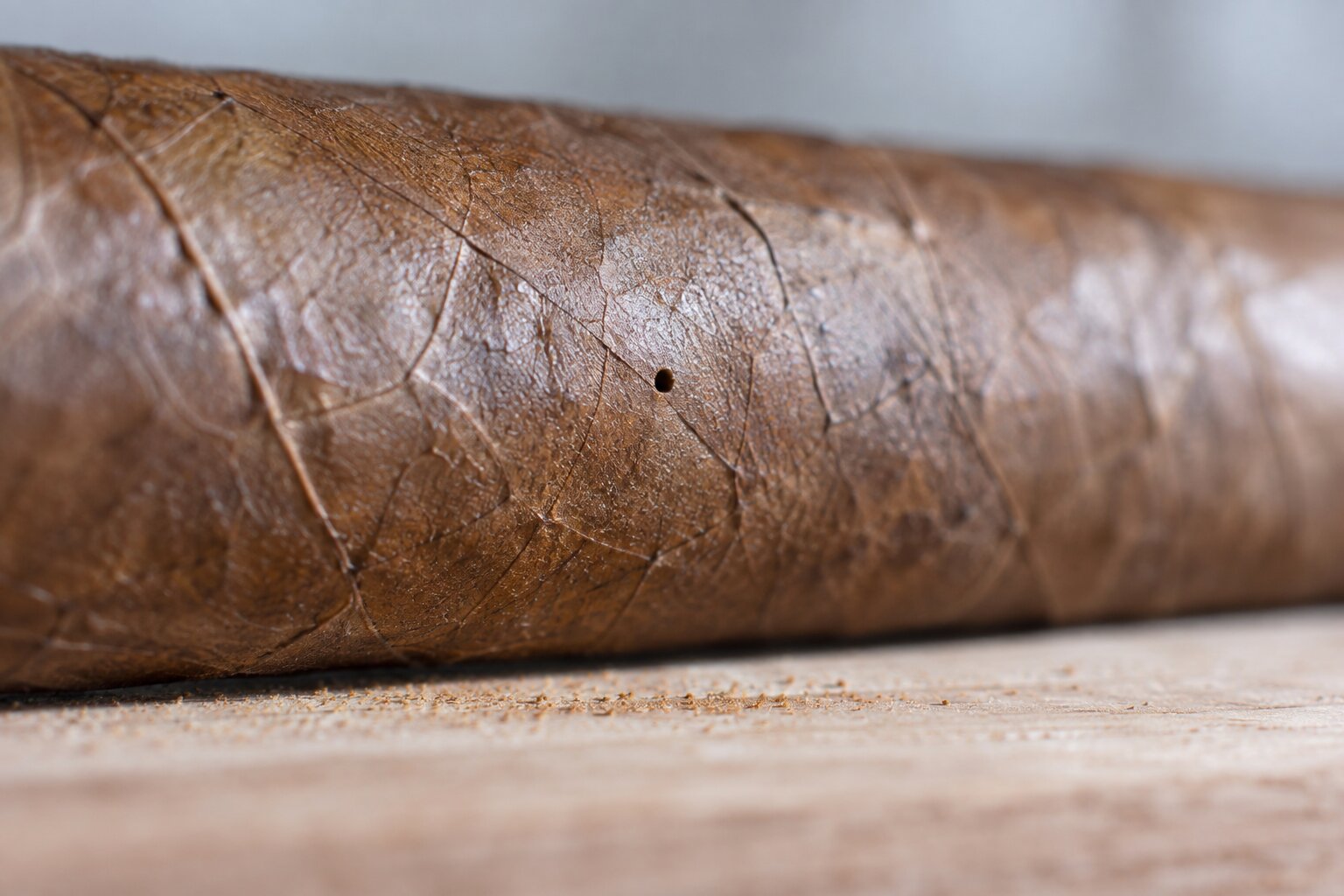
- Holes in the tobacco. Cigars attacked by these beetles have holes eaten through them (Penn State Extension). Look closely, because they're tiny and round.
- Tunnels. If you cut into or break a damaged cigar, you'll often find tunnels through the filler, where the larvae have fed.
- Fine powder. A light dusting on shelves or under boxes, left behind after feeding (IPM Working Group).
- Adult beetles near light. Small reddish-brown beetles on or near light fixtures and glass doors.
- Beetles in your traps—more on traps below.
Checking each box as it's faced or restocked is the cheapest early warning you have. It takes seconds per box, and it turns every restock into an inspection.
Prevention is mostly temperature.
Humidity gets most of the attention in a humidor. For beetles, temperature is the lever you control best.
- Hold the low end of the range. Aim for about 65°F, at the lower end of the recommended 65 to 70°F. That's the point at which adult beetles become active (Purdue Extension). Running colder provides protection: in one study, all beetle eggs died within six weeks at temperatures below 18°C (about 64°F; Imai and Harada, 2006). That's below the recommended range for cigars, though, so talk to your supplier before you go any colder.
- Log the temperature every day. A digital thermometer that records highs and lows, or one that alerts your phone when the room drifts. A daily log also shows you when a problem started.
- Plan for cooling failures. Know what you'll do if the air conditioning fails on a summer weekend. That might be a backup unit, or a service contract you can call on a Sunday.
- Keep heat away. Keep humidors out of direct sunlight and away from heat vents and air conditioning drafts (Lucrative Cigars FAQ).
- Keep humidity steady, not high. Keep it between 65 and 70%, since the beetles do best at 70 to 80%. This guide to keeping a retail humidor stable covers the day-to-day routine, and Lucrative stocks humidification supplies for cabinets and walk-ins.
- Keep stock moving. A box that sits through a whole summer gives beetles more time. Placing smaller, more frequent orders means fewer boxes waiting on the shelf.
- Keep food out of the stockroom. Move spices and snacks away from your humidor, and vacuum up spilled tobacco.
Receiving: use the first 48 hours
Deliveries are where new beetles come in, so the first look matters most. Check every box the day it arrives, not when you get around to shelving it. If you do find damage, the clock matters too. Lucrative asks for damage claims within 48 hours of delivery, with photos of the item and its packaging (returns policy).
A short quarantine won't reveal much on its own. Eggs take six to ten days to hatch, and larvae then feed out of sight for weeks (Penn State Extension). That's why anything suspicious should go straight to the freezer rather than sit in a corner waiting to show symptoms.
Should you freeze every delivery? It's a judgment call. Freezing everything removes the risk, but it requires labor and introduces condensation risks if done poorly. Freezing only suspect lots is less work, but it relies on your inspection. Pick one approach and write it down, so every delivery gets the same treatment.
Monitoring with pheromone traps
Tobacco warehouses monitor beetles with sticky traps baited with serricornin, the sex pheromone female beetles produce. In trials in tobacco warehouses in Greece, two commercial trap systems caught beetles equally well, and the lures stayed attractive for at least four weeks (Athanassiou et al., 2018).
For a shop or lounge, that translates into a simple routine. Put a trap in or beside each humidor, check it weekly, replace the lure about once a month, and write down what you find.
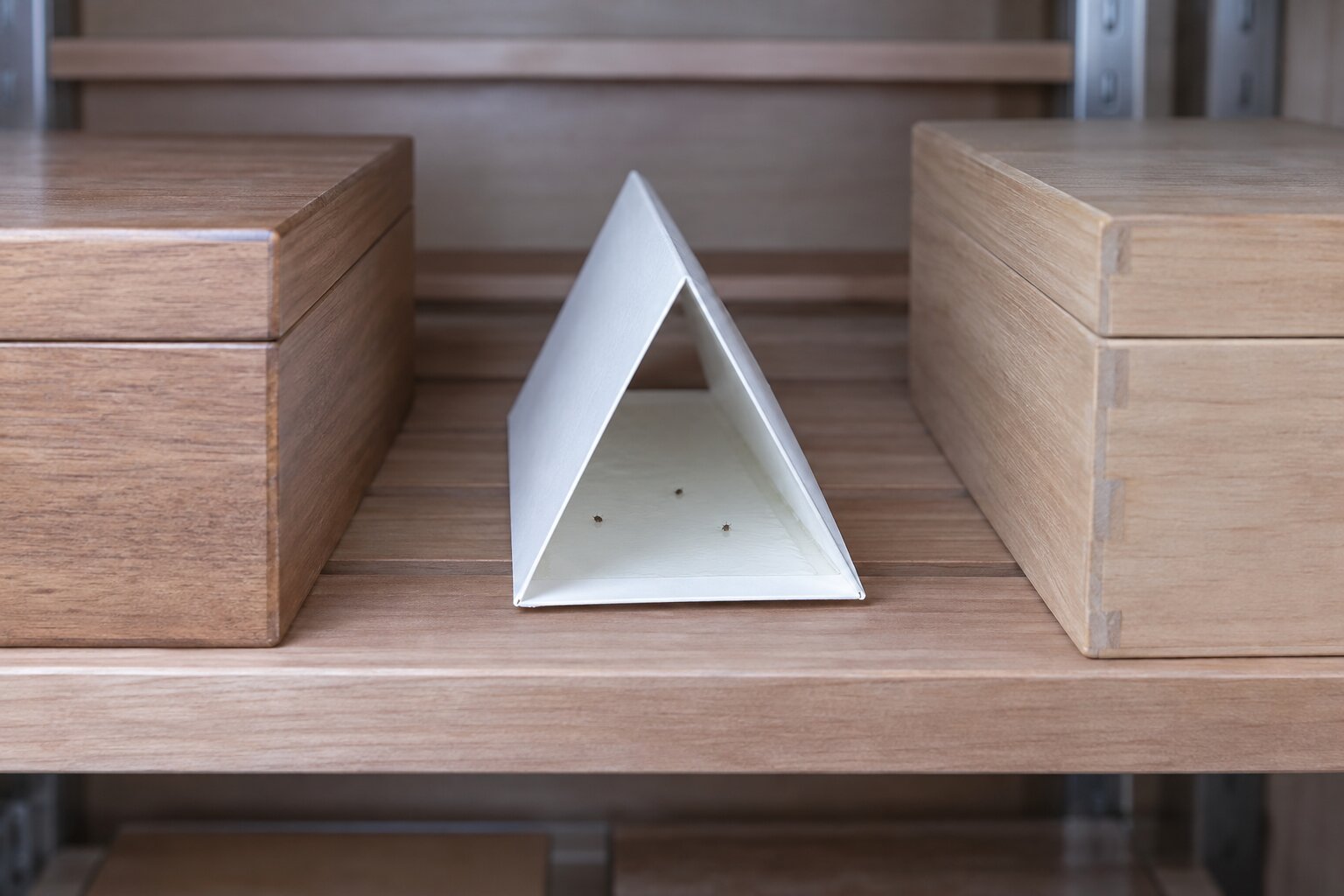
Treat a catch as an early warning, not proof of an outbreak. One or two beetles means you check the boxes nearest the trap and look hard at your temperature log. Catches that rise week after week mean it's time for the outbreak plan.
Don't spray insecticide in a humidor. Residual treatments only kill adults that are out in the open, not the larvae inside the tobacco (Purdue Extension). Cigars also take on the smell of whatever's around them.
If you find them: an outbreak plan
Move quickly, but in this order:
- Isolate. Bag affected boxes where they sit, so nothing escapes while you move them.
- Check the neighbors. Inspect every box on the same shelf and the shelves around it, and bag anything suspect.
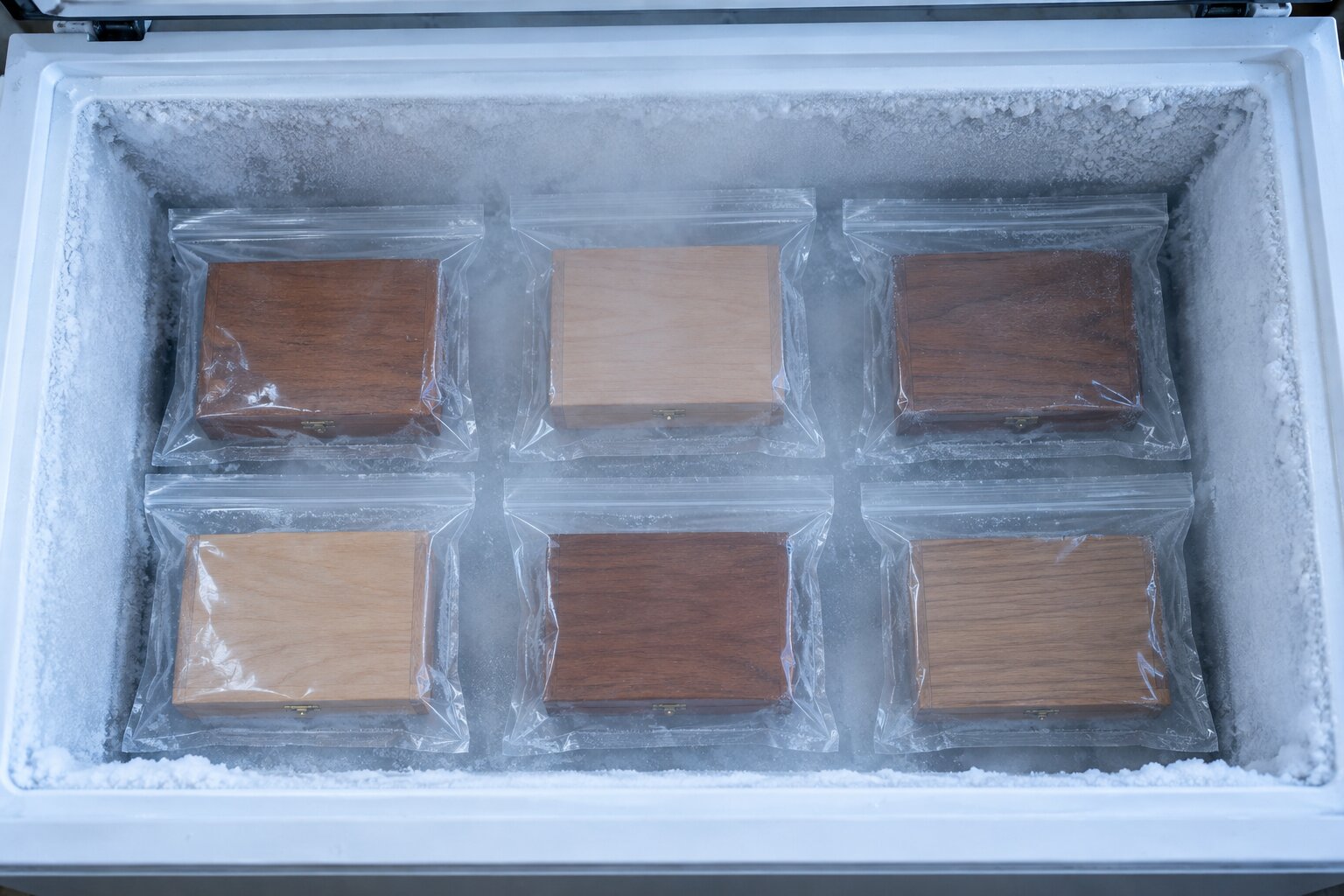
- Freeze. Seal each box in its own freezer bag with the air pressed out. Freeze at 0°F (−18°C) or colder for 72 hours, and check the freezer's real temperature with a thermometer.
- Thaw slowly, still sealed. Move the bags to a refrigerator for about a day, then to room temperature for another day, before you open them.
- Clean the humidor. Vacuum the shelves and corners, then dispose of the vacuum bag (IPM Working Group). Skip cleaning chemicals on the cedar.
- Find the cause. Look back through your temperature log for the warm spell that let them build up, and fix it.
- Document it. Keep photos, lot details, and dates for any supplier conversation and for your own records.
- Call a professional for a big outbreak. If beetles are spread through a walk-in, call a licensed pest control operator experienced in stored-product pest control. Fumigation is the commercial control for this beetle (Purdue Extension), and it's a job for licensed professionals.
Why 72 hours? In laboratory tests, the most cold-hardy stage (larvae acclimated to cooler temperatures) reached 99% mortality after 7.2 hours at −15°C (Imai and Harada, 2006). A freezer at −18°C is colder than that, and three days leave plenty of time for the middle of a packed box to get fully cold.
Pull any cigar with holes from sale. Freezing kills the beetles, but it doesn't repair the damage.
Does freezing hurt cigars?
The risk from freezing is mostly about moisture and sudden temperature swings. The cold itself is the point of the exercise.
Sealing each box keeps the moisture in the tobacco while it's frozen. The slow thaw matters because condensation forms on the coldest surface in warm air. You want that to be the outside of the bag, not your wrappers. After thawing, give the cigars time to settle back in the humidor before they go back on sale.
That's also why freezing works better as a response than as a habit. Every freeze-and-thaw cycle involves handling, time, and a chance for something to go wrong. Proper temperature control and thorough receiving checks mean you should rarely need to freeze anything.
Walk-ins and cabinets need different plans.
A cabinet humidor and a walk-in face the same beetle, but their responses look different.
A cabinet is small enough to handle as one unit. If you find beetles in one, the simplest move is often to empty it. Bag and freeze everything inside, clean the cabinet, and restock it once the frozen stock has thawed. Moving the whole contents means no box gets missed.
A walk-in holds too much stock to freeze in one go, and it has more places for beetles to hide. The plan changes:
- Zone it. Split the room into shelf zones and put a trap in each, so a catch point points you to one section instead of the whole room.
- Work outward. Start with the boxes where you found damage and move out shelf by shelf, freezing in batches your freezer can handle.
- Watch the door. A walk-in that's been open all evening exchanges air with the shop floor, so its temperature log matters even more.
- Know when to call for help. If catches continue to rise after you've frozen the affected zones, bring in a licensed pest control operator.
When a customer brings one back
Sooner or later, a regular will hand you a cigar with a hole in it. Treat it as both information and a complaint.
Replace or refund it the way you'd handle any damaged product. Then trace it back. Which box did it come from? Which delivery was that box in, and how long did it sit? Check that box and its neighbors on the same day, and review the trap and temperature logs for that shelf. A single returned cigar can be the first sign of a problem you haven't spotted yet.
Buy from a supplier that controls temperature, too
Your routine only covers stock once it's in your building. Before that, it sat in a distributor's warehouse, possibly for a summer. It's fair to ask any supplier how they store cigars and at what temperature they store them. Ask what happens when a delivery arrives damaged, too. This guide covers what to ask a wholesale cigar distributor, including storage.
Lucrative keeps its inventory in a climate-controlled humidor in Atlanta, and states its damage-claim window up front.
A weekly and monthly beetle routine
- Daily: Log the humidor's temperature and humidity.
- Every delivery: Inspect each box within 48 hours, and bag and freeze anything suspect.
- Weekly: Check every trap and write down the count.
- Weekly: Look over boxes while you face and restock, and clear any debris.
- Monthly: Replace trap lures.
- Monthly: Review the temperature log for warm days and find out why they happened.
- Monthly: Move older boxes forward so nothing sits for months. This guide to rotating stock through a lounge humidor covers the wider inventory side.
- Every season: Check the air conditioning before summer, and keep food and dried goods away from the humidor.
The short version
Tobacco beetles like warmth and humidity, and a humidor supplies plenty of both. They're active above 65°F, and at 70°F, they still develop, just more slowly. Warmer rooms speed them up sharply. That makes temperature your main defense. Hold the low end of the 65-70°F range, log it daily, and plan for a cooling failure before summer arrives.
Add the checks that catch them early. Inspect every delivery within 48 hours and keep pheromone traps in every humidor. Train anyone who restocks to spot holes and powder. If you do find beetles, isolate the boxes, freeze them, sealed, at 0°F for 72 hours, thaw them slowly, and clean the humidor.
When you're restocking, buy from a supplier that controls temperature as carefully as you do. You can apply for a wholesale account with Lucrative Cigars, which keeps stock in its climate-controlled Atlanta humidor.
Frequently asked questions
What do tobacco beetles look like?
Adults are about a tenth of an inch long, oval, and reddish-brown, with the head bent down so they look humped from the side. The larvae are small, yellowish-white grubs with a brown head. In cigars, you'll usually notice the damage before the beetles: tiny, round holes and fine powder.
What causes cigar beetles in a humidor?
They usually arrive in stock or on other stored goods, then multiply when conditions suit them. Adults become active above 65°F, and warmth accelerates their entire life cycle. A humidor that drifts warm, especially in summer, gives them what they need.
How do you get rid of cigar beetles?
Isolate the affected boxes, seal them in freezer bags, and freeze them at 0°F (−18°C) or colder for 72 hours. Thaw them slowly while still sealed, then clean the humidor and fix whatever lets the temperature rise. For a large outbreak in a walk-in, call a licensed pest control operator.
How long should you freeze cigars to kill beetles?
72 hours at 0°F (−18°C) or colder, with the cigars sealed in freezer bags. Lab work shows even the most cold-hardy larvae reach 99% mortality in about 7 hours at −15°C, so three days in a colder freezer leaves a wide margin. Thaw slowly before opening the bags.
How common are cigar beetles?
There are no reliable public figures for how often retail humidors get them. Researchers describe the species as one of the most serious insect pests of stored tobacco, so it is reasonable to assume that any delivery could carry them. Prevention and early detection cost far less than an outbreak.