Wholesale Cigar Distributor: How Do I Choose the Right One for My Cigar Shop?
Wholesale Cigar Distributor: How Do I Choose the Right One for My Cigar Shop?
by Lucrative Cigars Team
The right wholesale cigar distributor can significantly change the trajectory of your business by increasing the number of returning customers.
Retail cigar programs rarely fail because demand disappears; they fail because inventory decisions are made without a clear cigar inventory sourcing strategy. A humidor filled with inconsistent brands, slow-moving boxes, or poorly stored cigars quickly becomes a liability instead of a profit center. Many retailers discover too late that choosing the wrong wholesale cigar distributor can lead to cascading issues, including stale products, unpredictable margins, missed replenishment windows, and frustrated customers.
Consumers are increasingly drawn to premium cigars, with industry import data showing sustained high-volume levels even amid short-term fluctuations. That means the opportunity is real, but success depends heavily on choosing the right supplier relationship.
Every shop has its regulars. Learn how to find the right premium cigar distributor so your cigar shop is a haven for quality products and relaxation. With our distributor guide, retailers and lounge owners can learn what operational standards matter, how inventory strategy connects to supplier choice, and how to avoid the most common sourcing mistakes.
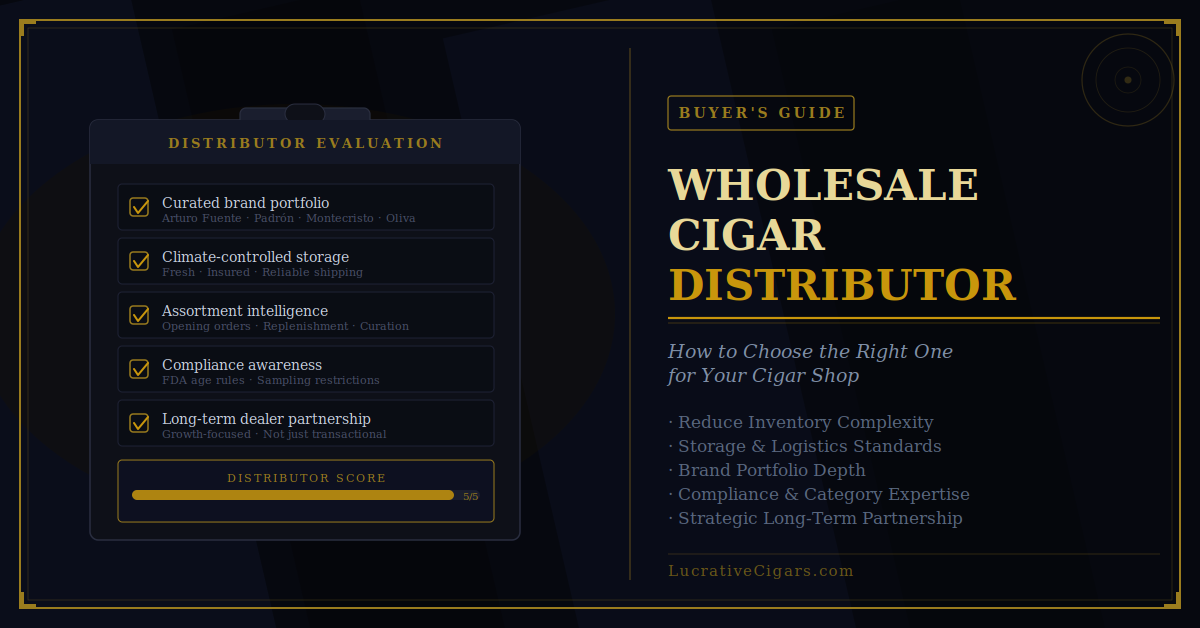
- A wholesale cigar distributor should reduce inventory complexity, not add to it.
- Climate-controlled storage and reliable logistics are essential for premium cigar quality.
- Strong brand portfolios enable better merchandising and customer confidence.
- Regulatory awareness helps retailers avoid costly compliance errors.
- Long-term distributor partnerships typically outperform short-term price-driven sourcing.
A great wholesale cigar distributor simplifies inventory decisions.
The most valuable role of a premium cigar distributor is not just to sell product, but to reduce decision friction. Retailers face hundreds of SKU choices across strength levels, wrapper types, price bands, and brand reputations. Without guidance, assortment planning becomes guesswork.
The Premium Cigar Association (PCA) emphasizes the importance of tailoring inventory to the specific market a retailer serves, noting that cigar shops must understand their customer demographics and preferences before building stock programs. That same logic applies to distributor selection: a supplier should help translate category complexity into practical inventory recommendations.
A distributor that curates assortments based on sell-through trends, seasonal demand, and brand recognition becomes an operational asset. For example, Lucrative Cigars highlights expert recommendations, top sellers, and hot-and-limited wholesale cigar selections across its product structure.
This type of merchandising intelligence helps retailers create balanced humidors without overcommitting capital to unfamiliar lines. A strong distributor relationship should also include guidance on opening orders, replenishment cadence, and category positioning, particularly for retailers entering cigars from adjacent segments such as spirits or convenience retail.
Ultimately, the right wholesale cigar distributor makes inventory feel structured instead of overwhelming. Retailers can focus on selling rather than decoding product complexity.
Storage, freshness, and logistics are non-negotiable standards for wholesale cigar distributors.
Premium cigars are sensitive products that require controlled humidity and temperature throughout the supply chain. Improper storage can affect draw quality, burn consistency, and flavor profile, all of which directly influence repeat purchase behavior. Retailers often assume that condition problems originate in-store, but upstream handling plays an equally critical role. A distributor that maintains climate-controlled storage until shipment substantially reduces the risk of product degradation before arrival.
Lucrative Cigars are stored in controlled-humidity environments and shipped fresh, insured. For B2B buyers, this level of transparency in handling is not simply reassuring; it is essential for protecting inventory investment. Retailers should also evaluate shipping speed, packaging quality, and order accuracy rates when comparing suppliers. Delays or damaged shipments can disrupt promotions, erode customer confidence, and force costly markdowns.
Improperly stored cigars are a logistical nightmare.
Logistics reliability also affects compliance. Age-restricted products require documented chain-of-custody practices, adult signature considerations for certain deliveries, and consistent labeling. While regulatory obligations ultimately sit with the retailer, working with a disciplined premium cigar distributor helps minimize operational risk. A supplier who treats logistics casually often signals broader organizational inconsistency, a warning sign serious retailers should not ignore.
Brand portfolio depth separates commodity suppliers from strategic partners.
Not all wholesale cigar distributors provide meaningful brand access. Some operate primarily as price aggregators with a limited breadth of premium inventory.
- Retailers focused on long-term humidor performance should prioritize suppliers with strong relationships across established cigar manufacturers. Recognizable brands such as Arturo Fuente, Padrón, Montecristo, Oliva, and My Father tend to anchor consumer confidence, particularly in markets where customers are building brand literacy.
- Retailers should assess exclusivity dynamics. Limited or hot releases can create urgency and drive foot traffic, but only if the distributor manages allocation responsibly. When every store has access to identical "exclusive" products, the promotional advantage disappears.
A thoughtful premium cigar distributor will help retailers leverage scarcity without creating supply volatility. Lucrative Cigars organizes its assortment around trusted industry names while also surfacing emerging releases and curated luxury cigar bundles. This balance allows retailers to satisfy both repeat buyers and exploratory shoppers.
A distributor with a limited portfolio depth forces retailers to substitute, which confuses customers and complicates merchandising constantly. Conversely, a broad yet curated portfolio enables better category storytelling: mild to full-bodied options, value to luxury tiers, and format diversity ranging from tins to full boxes.
Compliance awareness and category expertise protect retailer profitability.
Cigar retail is governed by age restrictions and marketing limitations that directly influence sourcing strategy.
- FDA guidance states that retailers may sell tobacco products only to customers aged 21 or older and must verify customers' identification if they appear younger.
- Promotional activities such as free sampling are restricted.
These rules shape merchandising decisions, event planning, and digital marketing tactics. A distributor familiar with regulatory boundaries can help retailers avoid costly missteps.
Category expertise extends beyond legal compliance. Experienced distributors understand regional demand patterns, pairing trends with spirits, and evolving consumer preferences toward boutique brands or sampler formats. They can provide insights into shelf-life expectations, rotation strategies, and optimal pricing ladders. Retailers benefit when their wholesale cigar distributor functions as a knowledge resource rather than a transactional vendor.
Lucrative Cigars signals category familiarity through structured product navigation, educational positioning, and curated brand representation. For retailers, this suggests a supplier relationship grounded in market awareness rather than opportunistic inventory dumping. In a nuanced category like premium cigars, informed sourcing decisions often determine whether the humidor becomes a destination or an afterthought.
Long-term wholesale cigar distributor relationships drive sustainable growth.
Choosing a wholesale cigar distributor should be approached as a strategic partnership decision, not a one-time procurement exercise. Retailers who change suppliers frequently to chase short-term discounts often experience inconsistent inventory performance and fragmented customer trust. Sustainable cigar programs rely on predictable replenishment cycles, collaborative merchandising planning, and mutual visibility into sales trends.
A distributor invested in dealer growth will provide onboarding guidance, periodic assortment reviews, and access to new releases aligned with store positioning. They may also support marketing initiatives, such as launch promotions or educational content that helps staff sell with confidence. Over time, this partnership model reduces friction across ordering, training, and customer engagement.
Lucrative Cigars positions itself as a curated wholesale partner rather than a commodity catalog. By emphasizing premium quality cigars, a structured assortment, and reliable fulfillment, the company aligns with retailers seeking stability in a complex category. A dealer relationship built on shared performance goals ultimately delivers stronger margins than one built solely on invoice price comparisons.
Evaluate your wholesale cigar distributor(s) in the next 30 days.
Retailers considering a new wholesale cigar distributor should begin with a structured evaluation process.
- Conduct an internal review of the humidor's performance. Identify top-selling SKUs, slow movers, and gaps in strength profiles or price tiers. This data establishes baseline requirements for any potential supplier.
- Request portfolio overviews from shortlisted distributors. Evaluate brand recognition levels, format diversity, and evidence of curated selection. Ask how opening orders are typically structured for stores like yours. Distributors who cannot articulate a recommended inventory mix may lack sufficient category insight.
- Assess operational standards. Confirm storage conditions, shipping timelines, damage policies, and order minimums. Reliable fulfillment protects cash flow and promotional planning. Also, review compliance support. FDA retail guidance highlights age-verification responsibilities and sampling restrictions, underscoring the importance of distributor awareness of regulatory frameworks.
- Pilot a limited order. Monitor sell-through rates, product condition, and customer feedback. Compare performance against existing inventory benchmarks. Retailers who approach distributor selection analytically rather than intuitively are far more likely to build profitable cigar programs.
A partner like Lucrative Cigars can help streamline this evaluation by providing curated access to premium cigars and transparent fulfillment practices.
Selecting a premium cigar distributor is one of the most consequential decisions a retailer or lounge owner will make when building a premium cigar program. The right partner simplifies inventory planning, protects product condition, provides access to trusted brands, and supports awareness of compliance.
Over time, this relationship transforms the humidor from a passive display into an active revenue driver. Retailers seeking consistent quality, curated selection, and dependable supply should view distributor choice as a strategic investment rather than a transactional purchase. If you are ready to strengthen your cigar assortment and work with a partner focused on long-term dealer success, contact Lucrative Cigars.
Become a dealer today. Apply now.
FAQs on Wholesale Cigar Distributors
What should retailers prioritize when choosing a wholesale cigar distributor?
Retailers should prioritize curated brand access, storage standards, fulfillment reliability, and category expertise rather than focusing solely on price.
How important is freshness when sourcing wholesale cigars?
Freshness is critical because storage conditions directly affect flavor, burn quality, and customer satisfaction.
Can liquor stores successfully sell premium cigars?
Yes. Liquor stores often benefit from pairing-driven cigar purchases, gift sales, and impulse upgrades when assortments are well structured.
Are there federal age restrictions for cigar sales?
Yes. FDA regulations require retailers to sell tobacco products only to customers aged 21 or older and to verify customers' IDs for those who appear younger.
How often should retailers review their cigar distributor relationships?
Retailers should review performance quarterly, focusing on sell-through, replenishment efficiency, and customer feedback.
Get started today with a reputable wholesale cigar distributor.
Lucrative Cigars is a premium cigar supplier for retailers seeking consistent quality, recognizable brands, and streamlined ordering processes for them and their customers. Let us help you build or grow your regulars' base.